 Photo – Liam McHenry
Visited Upon The Children is the solemnly-entitled new dance-theatre work from Eva Crainean's Dansatori; in this case, its 'company copii', or children's company (copii being a Romanian word, literally meaning 'small fry'). 'They are a family born into a generational curse. One, standing in truth, will begin to break the tie.' Mmm. It all sounds a bit movie blockbuster to me. 'He was a boy from the wrong side of the tracks. She was on the next train.' Avid readers, if there are any, will know I've something of an aversion to such obliqueness; not least in dance, an already inherently oblique artform, in terms of its narrative potential. Yes, you can point to the big story ballets, but one generally goes in with prior knowledge and there are copious sets and props to tell the tale. So one really has to look past any pretensions to narrative and focus in on the quality and character of the movement itself and the impressions left.
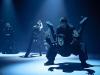
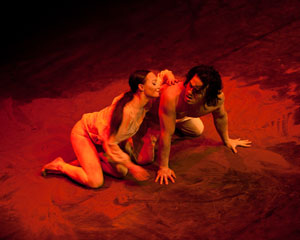
Crainean has already developed a distinctive 'house' style for Dansatori and characteristic motifs, postures and movements are beginning to emerge. Her choreography strikes me, ironically, as 'masculine', in the sense it's robust, with a certain violence, or brutality. This seems to be an expression of the force of her concerns, which she seeks to express urgently and with all the potency she can muster. I sense a burning need for her to do this. This work works very much on the horizontal plane. Performers caress, embrace; then push each other away. They drag themselves and each other across a stage strewn with dust. There's a portrayal of an almost unwitting, unbroken, virtually unbreakable, pre-programmed cycle of abuse, in which families, across generations, are mired in dirt. Old, ingrained habits die hard and nowhere moreso than between people related by blood. I just watched a television documentary in which Louis Theroux confronts Californian Nazis. Within one family, home-schooled children recite racist chants. One wonders if these poor girls will break free of poisonous beliefs. How. And when.
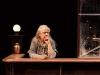
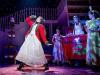
Intense pain can stem from obvious and overt behaviour, like 'love' that dare not speak its name. But it can also arise from even more sinister and, in a way, subtle things. Children or spouses can be as much abused and afflicted by trickery, intimidation and manipulation, for example, as by being physically struck. Being raised among addicts or narcissists can resonate for a lifetime. In this work, the bonds and chains that restrict growth and individuation are represented through repetitive, frenetic, angst-ridden movements of an almost autistic nature. This is a language of frustration; fit-to-bursting enforced containment. Crainean herself leads many of the ensemble scenes, bending and twisting her body into quite unnatural shapes. In so doing, she seems to be intimating perversity, in all its forms. Her choreography is, as always, challenging, conflictual and, sometimes, even ugly. One is asked to suspend conventional preconceptions about what dance is and where the lines are drawn between dance, theatre, acrobatics and perhaps other, more esoteric modalities. Depending on your reading, you might well imagine you've discerned references to myths, or recognise archetypes. By dint of a girl (Georgina Sadelowski) in a red dress, there seems to be something of a good-versus-evil dialectical invocation.
Music and lighting play pivotal roles in reflecting the drama of what's being presented. Sometimes, it's just the dim light cast upon the tableau vivant. At others, it's the voluptuous, tormented beauty of a classic, visually subverted and ruptured by anachronistic contortions. Or the soundscape takes on a percussive, primal texture, with vocalisations that could be construed as ecstatic, tortured, or both. And quite apart from her conceptual and choreographic endowments, one can't help but be overawed by Crainean's abilities as a mentor. These young (all under sixteen, save for Crainean's male lead, Dennis Sykes) dancers have been trained by her from scratch and all have a level of proficiency that would be daunting to many older, more experienced dancers. More than this, there's a tightness to the symmetry and harmony of the group, when onstage together that would be impressive were we speaking of a fully-professional company.
Crainean's vision is, as always, vigorous, determined and demanding. Demanding of the performers, but also of their audience. It isn't always lucid, but is most assuredly evocative. You won't like everything you see, but I don't reckon Crainean would expect or want that. I think she wants as much participation and activity from us as she and her dancers invest. And again, she's produced something which has me hankering (nay, hungering) to see what she gets up to next.
Dansatori’s Company Copii
Visited Upon The Children
Choreographed by Eva Crainean
Venue: Illawarra Performing Arts Centre
Dates: 12 & 13 October 2012
Bookings: 02 4224 5999